Hover bike
A low-poly single-seat hover bike parked on landing skids, with a hot-pink wedge fairing and two cyan-rimmed ducted lift fans fore and aft. Its looping idle animation spins the counter-rotating rotors, swings the handlebar and tilts the steering vanes.
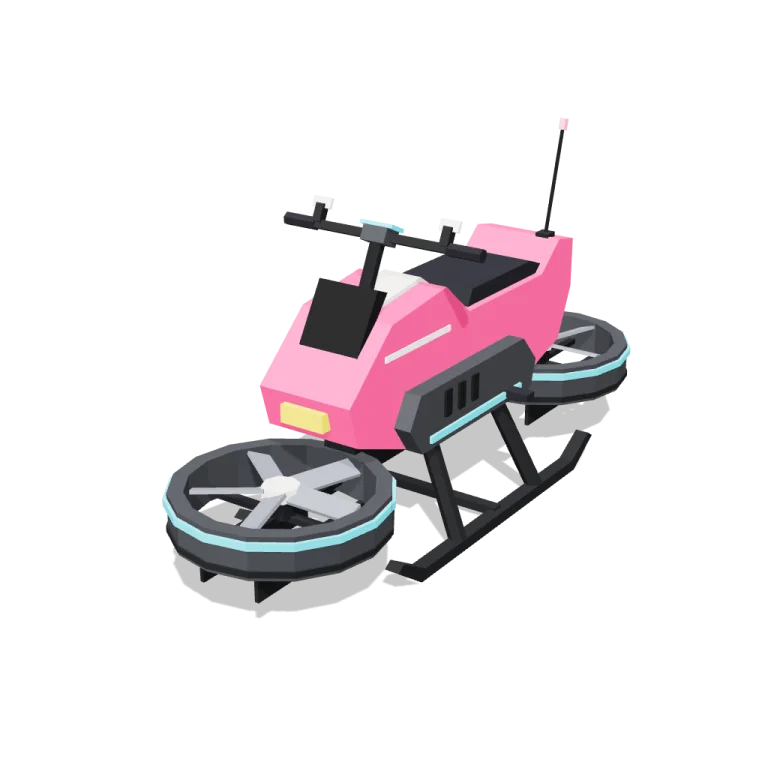
Left rail: colours and the 4 knobs the agent wrote into this model — they rebuild the geometry and go into your download. Right rail: looks for the viewer. Drag to orbit, scroll to zoom.
- Triangles
- 1,948
- Vertices
- 5,844
- Meshes · materials
- 35 · 10
- Size (W × H × D)
- 74 cm × 1.2 m × 2.3 m
- File
- GLB · 219 KB
- Animation
- scene-motion · 4.0s
- Style
- Low-poly
- Collection
- Cyberpunk Alley
Palette · named materials
- fairing#f64c84
- cowl#f2ede2
- engine#3a3c40
- frame#151619
- seat#1b1b22
- recess#090a0b
- blade#7d828c
- neonCyan#20c6df
- neonPink#f994b6
- lamp#eecd2b
Use it
import { GLTFLoader } from "three/addons/loaders/GLTFLoader.js";

const gltf = await new GLTFLoader().loadAsync(
  "https://assets.stoicsoft.com/1designtool/3d/models/cyberpunk-alley-hover-bike/9dfd26e7eb/model.glb"
);
scene.add(gltf.scene); // metres, +Y up, front faces +Z

const mixer = new THREE.AnimationMixer(gltf.scene);
gltf.animations.forEach((clip) => mixer.clipAction(clip).play());
// in your loop: mixer.update(delta)
How it was made
The brief given to 1DesignTool's “3D object” template:
Hover bike for the Cyberpunk Alley kit. Design it as one clear asset at believable real-world scale for that setting (state the size in metres in meta.notes), with its main parts modelled and named, readable at thumbnail size and from every orbit angle. It moves: author a seamless baked loop (2–12 s) with every pivot exactly at its hinge, axle or swivel, and keep the base still. This is one part of the Cyberpunk Alley kit (Low-poly style, flat-lowpoly direction): A rain-soaked back street under neon. Use ONLY the kit palette, by name: black #151619, neon pink #f994b6, cyan #20c6df, sodium yellow #eecd2b, black dark #090a0b, neon pink dark #f64c84, black light #3a3c40, neon pink light #fcdee8, soot black #1b1b22, warm white #f2ede2, mid grey #7d828c, dark wood #3d2a1c. Every material's `name` must be exactly the palette colour it uses — the GLB carries these names so the kit recolours as one; an unnamed material fails delivery. Kit knob: expose a param `neonColours` (0–1, default 0.5) for the kit's "Neon colours" setting wherever it makes sense on this part, and keep that id.
- Agent: Claude Code · Claude Opus 5.5 in 1DesignTool
- Generation: 3.84M tokens (95% cached) · ≈ $2.81 at API prices · 5-hour plan +7%
- Direction: Low-poly · family vehicles
- three-check PASS · glb-lint PASS — 0 errors, 3 heuristic warnings (verdict UNVERIFIED only because no requirements contract was supplied)
Named parts · 16
- Hover bike
- Landing skids
- Fairing
- Seat
- Lights and neon
- Thruster nozzle
- Antenna
- Handlebar
- Front duct
- Front rotor
- Front left vane
- Front right vane
- Rear duct
- Rear rotor
- Rear left vane
- Rear right vane
Note: Size at defaults: 2.26 m long × 0.74 m wide (over the handlebar grips) × 1.22 m tall to the antenna tip (about 1.09 m over the mirrors; seat height 0.78 m). Origin is at the bottom centre, the skids rest on y = 0, and the front faces +Z. 1948 triangles, 35 meshes and 10 materials, each named exactly after its kit palette colour. Baked clip 'scene-motion' is a seamless 4 s loop. The rotors spin about their duct axles (8 whole turns per loop, counter-rotating), the handlebar swivels ±0.3 rad about the raked steering axis, and the four vanes swing ±0.28 rad about their top hinge rails. The skids and fairing never move. neonColours sets the emissive strength of the cyan duct rims, side strips, nozzle glow, pink tail light and antenna tip, and the sodium headlight (0 = unlit paint). It is baked into the GLB's emissive values at export. ductRadius, ductSpacing and bladeCount reshape the fans; the default GLB is the shipped variant. Every part node carries its library id (cyberpunk-alley-hover-bike.*) in extras.partId and wraps a twin node with a kit-grammar id (hoverbike.*), because the design kit's part-id pattern does not allow hyphens. Node names use '_' in place of '.' so the animation tracks bind on import. glb-lint heuristic warnings are expected: primitives are non-indexed because of flat-shaded facets, nested or embedded joins (cowl, engine block and pylons in the fairing) overlap on purpose, and the 'detached' parts touch neighbouring groups (seat on the fairing, vanes on the duct hinge rails) rather than siblings.
About the Hover bike 3D model
Hover bike is a free animated low-poly 3D model from the Cyberpunk Alley set. It measures 74 cm × 1.2 m × 2.3 m (W × H × D) at real-world scale and is built from 1,948 triangles across 35 meshes, with 16 named parts and a baked animation (4.0 s). Download the 219 KB GLB and drop it into three.js, React Three Fiber, Godot or Blender — free for commercial use, no attribution required.
- Is the Hover bike 3D model free for commercial use?
- Yes. It is free under the 1DesignTool 3D library license: use it in personal and commercial work — games, apps, websites, renders, ads and client projects — and modify it as you like, with no credit required. What you can't do is re-sell or re-distribute the file on its own or inside a model pack.
- What file format is it, and how big is it?
- A single binary glTF 2.0 file (.glb), 219 KB: 1,948 triangles, 5,844 vertices and 10 materials, modelled in metres at 74 cm × 1.2 m × 2.3 m.
- Is Hover bike animated?
- Yes — the GLB carries a baked animation (4.0 s), ready to play with any glTF animation mixer.
- Which engines and tools can open it?
- Anything that reads glTF 2.0. three.js, React Three Fiber, Babylon.js, Godot 4 and Blender import the GLB directly; Unity and Unreal Engine load it through their glTF importers. The snippets above show the exact code for three.js, React Three Fiber, Godot and Blender.
- How was the Hover bike 3D model made?
- Claude Code (Claude Opus 5.5) generated it inside 1DesignTool's 3D template from a written brief, then the design kit's checks verified the geometry and the GLB before it was published. You can make your own the same way with 1DesignTool.
More like this
All of Cyberpunk Alley →
Sliding shutter
Cyberpunk Alley1,460 tris

Flickering sign
Cyberpunk Alley1,992 tris

Delivery drone
Cyberpunk Alley1,796 tris

Crates
Cyberpunk Alley1,148 tris

Steam vents
Cyberpunk Alley3,888 tris

Holo adverts
Cyberpunk Alley656 tris

Trash bags
Cyberpunk Alley1,536 tris

Air conditioners
Cyberpunk Alley2,252 tris
Free under the 1DesignTool 3D library license. Model #1427 of 1941.