Overhead walkways
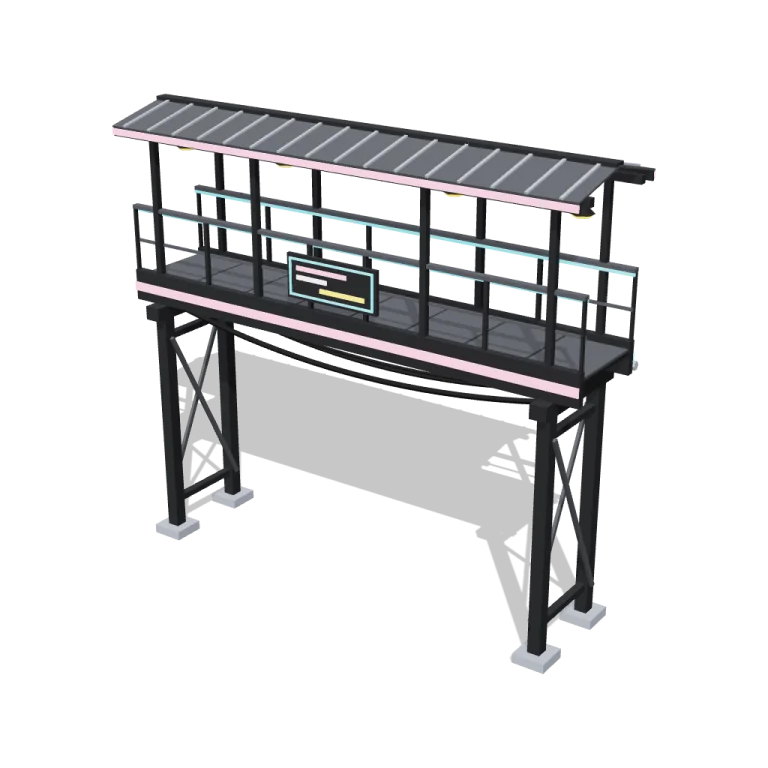
A modular covered steel footbridge for the Cyberpunk Alley street, built in sections that chain end to end. Its grated deck sits 4.5 m up on X-braced steel trestles, with neon strips along the deck edges, rails and eaves, a gabled corrugated canopy with hanging sodium lamps, draped cables and an abstract neon sign.
Left rail: colours and the 4 knobs the agent wrote into this model — they rebuild the geometry and go into your download. Bottom: what the model does — the one you pick plays here and is baked into the download. Right rail: looks for the viewer. Drag to orbit, scroll to zoom. On a desktop, Open in 1DesignTool turns it into a project you can keep editing with your agent.
- Triangles
- 2,438
- Vertices
- 7,314
- Meshes · materials
- 23 · 23
- Size (W × H × D)
- 8.0 m × 7.3 m × 2.2 m
- File
- GLB · 193 KB
- Animation
- Static
- Style
- Low-poly
- Collection
- Cyberpunk Alley
Palette · named materials
- black#151619
- black dark#090a0b
- black light#3a3c40
- mid grey#7d828c
- neon pink#f994b6
- neon pink light#fcdee8
- cyan#20c6df
- sodium yellow#eecd2b
Use it
import { GLTFLoader } from "three/addons/loaders/GLTFLoader.js";

const gltf = await new GLTFLoader().loadAsync(
  "https://assets.stoicsoft.com/1designtool/3d/models/cyberpunk-alley-overhead-walkways/d42ae572ef/model.glb"
);
scene.add(gltf.scene); // metres, +Y up, front faces +Z
How it was made
The brief given to 1DesignTool's “3D object” template:
Overhead walkways for the Cyberpunk Alley kit. Design it as one clear asset at believable real-world scale for that setting (state the size in metres in meta.notes), with its main parts modelled and named, readable at thumbnail size and from every orbit angle. It is a modular piece that snaps on a 1 m grid: give it a length in whole metres and put the origin at its snapping end, stated in meta.notes. This is one part of the Cyberpunk Alley kit (Low-poly style, flat-lowpoly direction): A rain-soaked back street under neon. Use ONLY the kit palette, by name: black #151619, neon pink #f994b6, cyan #20c6df, sodium yellow #eecd2b, black dark #090a0b, neon pink dark #f64c84, black light #3a3c40, neon pink light #fcdee8, soot black #1b1b22, warm white #f2ede2, mid grey #7d828c, dark wood #3d2a1c. Every material's `name` must be exactly the palette colour it uses — the GLB carries these names so the kit recolours as one; an unnamed material fails delivery. Kit knob: expose a param `neonColours` (0–1, default 0.5) for the kit's "Neon colours" setting wherever it makes sense on this part, and keep that id.
- Agent: Claude Code · Claude Opus 5.5 in 1DesignTool
- Generation: 2.01M tokens (92% cached) · ≈ $2.23 at API prices · 5-hour plan +5%
- Direction: Low-poly · family scenes
- three-check PASS · glb-lint PASS (0 errors, 6 non-blocking heuristic warnings)
Named parts · 9
- Overhead walkway
- Deck
- Railings
- Support trestles
- Canopy
- Neon strips
- Sodium lamps
- Cables and pipe
- Neon sign
Note: Static model, about 8.0 m long x 7.27 m high x 2.2 m deep at default params. The deck top is 4.5 m above the street, the walkway is 1.32 m wide between curbs (1.6 m over the stringers), the rails are 1.1 m high and the canopy eaves are about 2.45 m above the deck. Modular, snapping on a 1 m grid: the module length is a whole number of metres (3-12, default 8) along +X. The origin is at the bottom centre of the snapping end (x = 0, z centred, y = 0), and the piece runs from x = 0 to x = length. Deck, rails, eaves, canopy sheets and the pipe span exactly that range, and posts, joists, deck seams and trestle bents sit on half-metre stations, so modules butt together cleanly. The half-thickness end posts on each snapping face pair up into one spliced post when two modules are chained. The front (long side, with the sign) faces +Z and the model rests on y = 0; the ground disc is staging only and is not in the GLB. Params: neonColours (0-1) sets the pink/cyan mix of the neon strips and sign: 0 = all cyan, 1 = all pink, 0.5 = an even interleave. length adds trestles and canopy trusses as it grows (a third trestle from 9 m). deckHeight raises the deck, and cableSag sets how far the under-deck cables droop. All four rebuild the geometry. Every material is named exactly after the Cyberpunk Alley palette colour it uses; the neon and sodium lamps are emissive on those same named materials. Flat shading is baked into the geometry as face normals, so it survives export. Part ids use the slug without hyphens (cyberpunkalleyoverheadwalkways) because the kit's part-id grammar only allows lowercase letters, digits, underscores and dots. The exporter clones materials per mesh, so the GLB has 23 material slots, all using the 8 palette names. glb-lint's warnings are expected for this build method: material count, duplicate materials, non-indexed flat-shaded geometry, sibling overlap, lamps/cables/sign touching parts in other groups, and scale against a 1 m reference. The GLB has no animation clips.
About the Overhead walkways 3D model
Overhead walkways is a free low-poly 3D model from the Cyberpunk Alley set. It measures 8.0 m × 7.3 m × 2.2 m (W × H × D) at real-world scale and is built from 2,438 triangles across 23 meshes, with 9 named parts. Download the 193 KB GLB and drop it into three.js, React Three Fiber, Godot or Blender — free for commercial use, no attribution required.
- Is the Overhead walkways 3D model free for commercial use?
- Yes. It is free under the 1DesignTool 3D library license: use it in personal and commercial work — games, apps, websites, renders, ads and client projects — and modify it as you like, with no credit required. What you can't do is re-sell or re-distribute the file on its own or inside a model pack.
- What file format is it, and how big is it?
- A single binary glTF 2.0 file (.glb), 193 KB: 2,438 triangles, 7,314 vertices and 23 materials, modelled in metres at 8.0 m × 7.3 m × 2.2 m.
- Can I animate Overhead walkways?
- It ships as a static mesh. Its 9 named parts are separate nodes, so you can move or animate each one in your engine.
- Which engines and tools can open it?
- Anything that reads glTF 2.0. three.js, React Three Fiber, Babylon.js, Godot 4 and Blender import the GLB directly; Unity and Unreal Engine load it through their glTF importers. The snippets above show the exact code for three.js, React Three Fiber, Godot and Blender.
- How was the Overhead walkways 3D model made?
- Claude Code (Claude Opus 5.5) generated it inside 1DesignTool's 3D template from a written brief, then the design kit's checks verified the geometry and the GLB before it was published. You can make your own the same way with 1DesignTool.
More like this
All of Cyberpunk Alley →
Cyberpunk Android
Cyberpunk Alley2,868 tris

Cyberpunk Hacker
Cyberpunk Alley2,444 tris

Cyberpunk Enforcer
Cyberpunk Alley3,856 tris

Cyberpunk Street Vendor
Cyberpunk Alley2,890 tris

Sliding shutter
Cyberpunk Alley1,460 tris

Flickering sign
Cyberpunk Alley1,992 tris

Delivery drone
Cyberpunk Alley1,796 tris

Hover bike
Cyberpunk Alley1,948 tris
Free under the 1DesignTool 3D library license. Model #1857 of 2361.