Roman Legionary
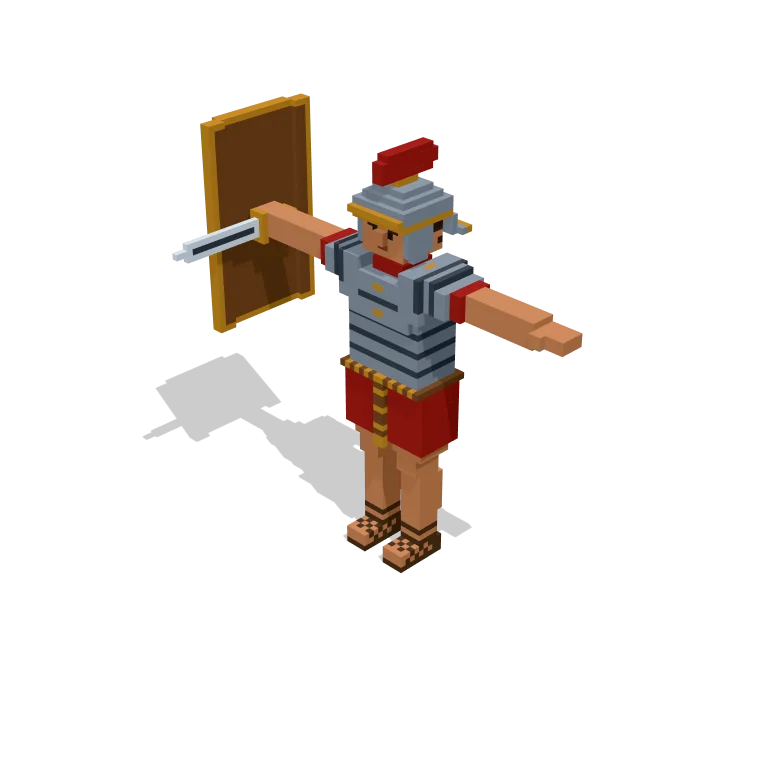
A fit voxel Roman legionary in his 20s in a crested steel helmet, segmented steel armour over a red tunic, a bronze-plated belt and open-work sandals, holding a short sword and a tall curved red shield in his right hand. Rigged in T-pose on the shared Mixamo-named skeleton.
Left rail: colours and the 4 knobs the agent wrote into this model — they rebuild the geometry and go into your download. Bottom: actions for the rigged character — the one you pick plays here and is baked into the download. Right rail: looks for the viewer. Drag to orbit, scroll to zoom. On a desktop, Open in 1DesignTool turns it into a project you can keep editing with your agent.
- Triangles
- 5,348
- Vertices
- 30,744
- Meshes · materials
- 24 · 24
- Size (W × H × D)
- 2.0 m × 2.0 m × 88 cm
- File
- GLB · 573 KB
- Animation
- Static
- Style
- Voxel
Palette · named materials
- skin#a06b4a
- hair#2b1e17
- eyes#18140f
- lips#683a2d
- top#7e1915
- steel#6c7681
- steelDark#353b43
- accent#9a6c22
- belt#5b3a22
- shoes#3d2a1b
- prop#aeb7c0
- shield#761612
Use it
import { GLTFLoader } from "three/addons/loaders/GLTFLoader.js";

const gltf = await new GLTFLoader().loadAsync(
  "https://assets.stoicsoft.com/1designtool/3d/models/roman-legionary/ef7b617601/model.glb"
);
scene.add(gltf.scene); // metres, +Y up, front faces +Z
How it was made
The brief given to 1DesignTool's “3D object” template:
A man in his 20s, fit, about 1.76 m tall. Disciplined expression. Wearing: crested helmet, segmented armour, red tunic, sandals. Palette: red, steel, bronze. Holding short sword and tall shield in the right hand. Voxel style. No text, logos, brand names or lettering anywhere.
- Agent: Claude Code · Claude Opus 5.5 in 1DesignTool
- Direction: Voxel · family characters
- three-check PASS · glb-lint PASS
Named parts · 9
- Body
- Crested helmet
- Segmented armour
- Red tunic
- Belt
- Centre apron strap and tunic gusset
- Sandals
- Short sword
- Tall shield
Note: 5,348 triangles on one voxel grid (58 rows to the skull top at 1.76 m, cell ≈ 3.03 cm). Soles are at y = 0 and he faces +Z. The helmet bowl rises to about 1.85 m and the crest to 2.00 m, so the file's bounding box is 2.0 m tall. 25 mixamorig bones, no finger bones: the left hand is a flat block and the right hand is a block fist. Every bone has an identity rest rotation (world-aligned), so retarget Mixamo or other clips by bone name with a rest-pose-aware retargeter (Blender, Unity Humanoid, Godot BoneMap, three.js SkeletonUtils.retargetClip) rather than copying raw Mixamo quaternions. Nine skinned meshes share one skeleton (the exporter writes one glTF skin per mesh, all with the same 25 joints). Each vertex has at most 4 weights, normalised. Weights blend over about 2 cells at every joint, 3 cells vertically round the hips and 3 cells horizontally round the shoulders. As the brief asks, the short sword and the tall shield are both in the right hand: the sword points forward out of the fist, and the shield stands on the outside of the fist on a short grip strap. Both are separate meshes weighted 100% to mixamorig:RightHand; set showSword or showShield to 0 to build without them. Because the shield is about 1 m tall and rides on the hand, arm animations swing it widely and it can pass through the legs or head in some clips. The helmet, cheek guards, neck guard and crest are one rigid mesh weighted 100% to mixamorig:Head. The tunic skirt is two panels, each following its own thigh. A rigid gusset and the studded centre apron strap close the gap between them. They are weighted 100% to mixamorig:Hips, so they stay put in a stride while the side panels swing, and a high knee can push the thigh panel through the strap. The shoulder hoops of the armour follow the shoulder and upper-arm bones. The face (level brows, eyes, closed mouth) is painted cells with no blendshapes. The shield decoration is a bronze rim, spine, boss and four stepped wing marks, with no letters or emblems. In three.js, GLTFLoader strips ':' and '.' from names (mixamorigHips, roman-legionarybody). The exporter writes one material copy per mesh, so the GLB has 24 material entries for 12 roles. No textures, lights, cameras or animation clips. glb-lint reports 0 errors. Its 5 warnings are heuristic: material count, duplicate per-mesh materials, nested clothing, the shield's box only touching the fist, and the 2 m bounds against a 1 m reference. It reports UNVERIFIED only because no requirements contract was supplied. scripts/rig-test.mjs passes 17 of 17 checks; the worst edge ratio in the test pose is 0.22–1.73, at the front hip crease of the tunic.
About the Roman Legionary 3D model
Roman Legionary is a free voxel 3D model from the Western, pirate and historical characters set, rigged with a 25-bone Mixamo-compatible skeleton. It measures 2.0 m × 2.0 m × 88 cm (W × H × D) at real-world scale and is built from 5,348 triangles across 24 meshes, with 9 named parts. Download the 573 KB GLB and drop it into three.js, React Three Fiber, Godot or Blender — free for commercial use, no attribution required.
- Is the Roman Legionary 3D model free for commercial use?
- Yes. It is free under the 1DesignTool 3D library license: use it in personal and commercial work — games, apps, websites, renders, ads and client projects — and modify it as you like, with no credit required. What you can't do is re-sell or re-distribute the file on its own or inside a model pack.
- What file format is it, and how big is it?
- A single binary glTF 2.0 file (.glb), 573 KB: 5,348 triangles, 30,744 vertices and 24 materials, modelled in metres at 2.0 m × 2.0 m × 88 cm.
- Is Roman Legionary animated?
- It ships without a baked clip, in its bind pose. It is rigged with a 25-bone Mixamo-compatible skeleton, so it takes retargeted animation.
- Which engines and tools can open it?
- Anything that reads glTF 2.0. three.js, React Three Fiber, Babylon.js, Godot 4 and Blender import the GLB directly; Unity and Unreal Engine load it through their glTF importers. The snippets above show the exact code for three.js, React Three Fiber, Godot and Blender.
- How was the Roman Legionary 3D model made?
- Claude Code (Claude Opus 5.5) generated it inside 1DesignTool's 3D template from a written brief, then the design kit's checks verified the geometry and the GLB before it was published. You can make your own the same way with 1DesignTool.
More like this
All of Western, pirate and historical characters →
Flapper
Western, pirate and historical characters42.8k tris

Victorian Chimney Lad
Western, pirate and historical characters12.9k tris

Explorer
Western, pirate and historical characters747 tris

Pharaoh
Western, pirate and historical characters3,707 tris

Musketeer
Western, pirate and historical characters21.3k tris

Gold Prospector
Western, pirate and historical characters29k tris

Bounty Hunter
Western, pirate and historical characters14k tris

Gladiator
Western, pirate and historical characters114.9k tris
Free under the 1DesignTool 3D library license. Model #351 of 2361.