Low-poly Octopus
A flat-shaded low-poly common octopus resting on the seabed with its bulbous mantle raised, two big bulging eyes and eight tapering arms spread out, with rows of cream suckers and curled-up tips. About 0.9 m across the spread arms, game-ready at about 3,500 triangles.
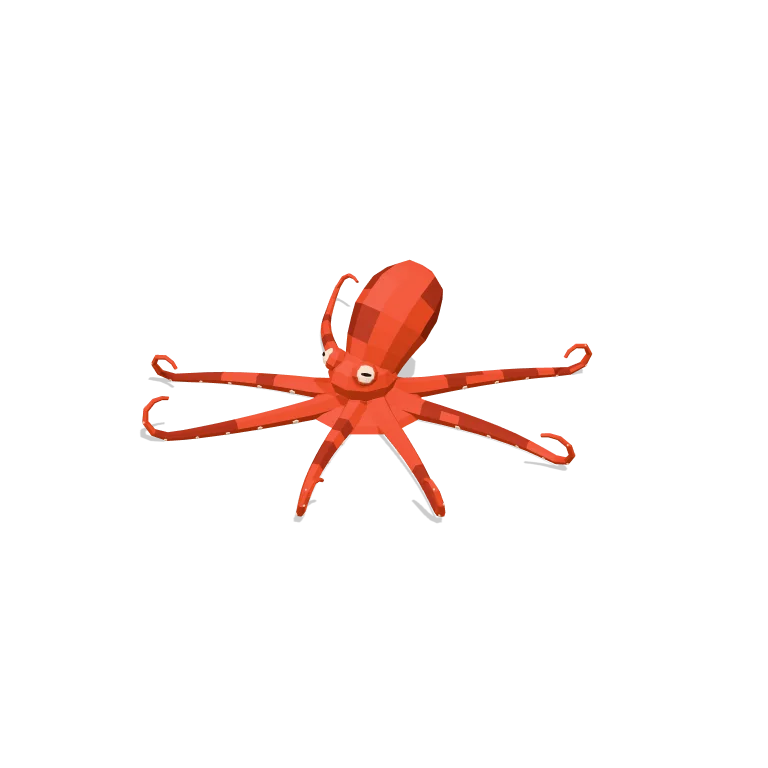
Left rail: colours and the 3 knobs the agent wrote into this model — they rebuild the geometry and go into your download. Bottom: what the model does — the one you pick plays here and is baked into the download. Right rail: looks for the viewer. Drag to orbit, scroll to zoom. On a desktop, Open in 1DesignTool turns it into a project you can keep editing with your agent.
- Triangles
- 3,540
- Vertices
- 10,620
- Meshes · materials
- 8 · 8
- Size (W × H × D)
- 81 cm × 26 cm × 80 cm
- File
- GLB · 257 KB
- Animation
- Static
- Style
- Low-poly
- Collection
- Low-poly Animals
Palette · named materials
- body#c8452a
- accent#8e2c1c
- trim#f0d9c4
- eye#24130f
Use it
import { GLTFLoader } from "three/addons/loaders/GLTFLoader.js";

const gltf = await new GLTFLoader().loadAsync(
  "https://assets.stoicsoft.com/1designtool/3d/models/lowpoly-octopus/96c341f7b0/model.glb"
);
scene.add(gltf.scene); // metres, +Y up, front faces +Z
How it was made
The brief given to 1DesignTool's “3D object” template:
A common octopus, about 0.9 m across with its arms spread, resting on the seabed with its soft head raised and its eight arms curling outward. Bulbous soft head, two large eyes, and eight tapering arms with rows of pale suckers on the undersides, curling at the tips. Colours: orange-red #c8452a, deep red #8e2c1c for the skin patches, pale cream suckers #f0d9c4. Static, posed naturally, standing on the ground at y = 0. Low-poly, flat-shaded faceted forms. No text, logos or lettering.
- Agent: Claude Code · Claude Opus 5.5 in 1DesignTool
- Direction: Low-poly · family characters
- three-check PASS · glb-lint PASS
Named parts · 6
- Octopus
- Mantle
- Head and web
- Eyes
- Arms
- Suckers
Note: Size at the default build: 0.81 m (x) by 0.80 m (z) bounding box, about 0.9 m tip to tip across the diagonal arms, and 0.265 m tall to the top of the mantle. The origin is at the bottom centre, the arms rest on y = 0 and the eyes face +Z. The model is static and has no animation clip. The GLB has 3,540 triangles in 8 meshes, one per part and material. Flat normals are baked in, so the mesh is non-indexed and stays faceted in any engine. The palette is four role-named materials: body (orange-red skin), accent (deep red mottled patches), trim (cream suckers and eyeballs) and eye (dark slit pupils). The exporter writes one material copy per mesh, so materials repeat by name. Params are baked at export, so the GLB is always the default build. armLength and armCurl reshape the arms and mantleSize scales the mantle. glb-lint reports 0 errors. Its warnings are expected for this pipeline: duplicate material copies, non-indexed flat-shaded geometry, overlapping part boxes where the eyes, mantle and arms meet the head, and a low height heuristic because the animal is flat and wide. plan-check's part-id regex rejects the hyphenated slug ids that the library requires, so the plan was validated on a de-hyphenated copy, which passed. three-check accepts the hyphenated ids.
About the Low-poly Octopus 3D model
Low-poly Octopus is a free low-poly 3D model from the Low-poly Animals set. It measures 81 cm × 26 cm × 80 cm (W × H × D) at real-world scale and is built from 3,540 triangles across 8 meshes, with 6 named parts. Download the 257 KB GLB and drop it into three.js, React Three Fiber, Godot or Blender — free for commercial use, no attribution required.
- Is the Low-poly Octopus 3D model free for commercial use?
- Yes. It is free under the 1DesignTool 3D library license: use it in personal and commercial work — games, apps, websites, renders, ads and client projects — and modify it as you like, with no credit required. What you can't do is re-sell or re-distribute the file on its own or inside a model pack.
- What file format is it, and how big is it?
- A single binary glTF 2.0 file (.glb), 257 KB: 3,540 triangles, 10,620 vertices and 8 materials, modelled in metres at 81 cm × 26 cm × 80 cm.
- Can I animate Low-poly Octopus?
- It ships as a static mesh. Its 6 named parts are separate nodes, so you can move or animate each one in your engine.
- Which engines and tools can open it?
- Anything that reads glTF 2.0. three.js, React Three Fiber, Babylon.js, Godot 4 and Blender import the GLB directly; Unity and Unreal Engine load it through their glTF importers. The snippets above show the exact code for three.js, React Three Fiber, Godot and Blender.
- How was the Low-poly Octopus 3D model made?
- Claude Code (Claude Opus 5.5) generated it inside 1DesignTool's 3D template from a written brief, then the design kit's checks verified the geometry and the GLB before it was published. You can make your own the same way with 1DesignTool.
More like this
All of Low-poly Animals →
Low-poly Honeybee
Low-poly Animals1,748 tris

Low-poly Cobra
Low-poly Animals1,438 tris

Low-poly Ostrich
Low-poly Animals2,162 tris

Low-poly Toucan
Low-poly Animals970 tris

Low-poly Frog
Low-poly Animals2,068 tris

Low-poly Clownfish
Low-poly Animals2,044 tris

Low-poly Meerkat
Low-poly Animals1,282 tris

Low-poly Gorilla
Low-poly Animals1,932 tris
Free under the 1DesignTool 3D library license. Model #64 of 2361.