Bounty Droid
A tall, angular 2 m robot bounty hunter with a single red eye under a scowling brow plate, bare steel plating, a tattered olive poncho, an ammo bandolier and belt, and a long rifle in its right hand. Low-poly and rigged in T-pose on the library's shared Mixamo-named skeleton.
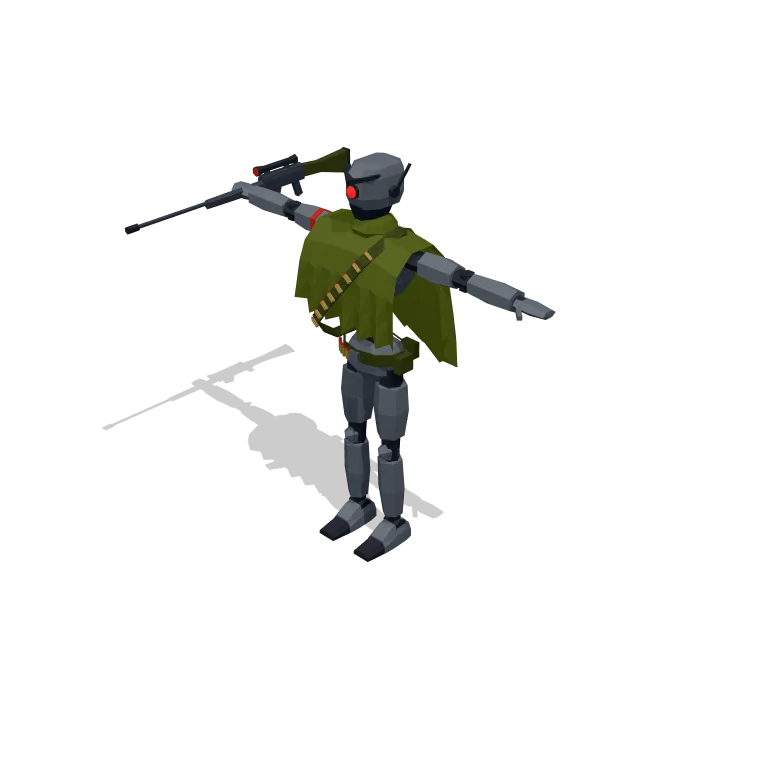
Left rail: colours and the 4 knobs the agent wrote into this model — they rebuild the geometry and go into your download. Bottom: actions for the rigged character — the one you pick plays here and is baked into the download. Right rail: looks for the viewer. Drag to orbit, scroll to zoom. On a desktop, Open in 1DesignTool turns it into a project you can keep editing with your agent.
- Triangles
- 2,632
- Vertices
- 23,928
- Meshes · materials
- 13 · 8
- Size (W × H × D)
- 2.0 m × 2.0 m × 1.4 m
- File
- GLB · 409 KB
- Animation
- Static
- Style
- Low-poly
- Collection
- Sci-fi and space characters
Palette · named materials
- skin#4d5259
- trim#202327
- top#3f4819
- belt#2c3016
- ammo#7d6c3a
- accent#8c1a12
- eye#6e0b05
- prop#33373c
Use it
import { GLTFLoader } from "three/addons/loaders/GLTFLoader.js";

const gltf = await new GLTFLoader().loadAsync(
  "https://assets.stoicsoft.com/1designtool/3d/models/bounty-droid/3c4fc674b4/model.glb"
);
scene.add(gltf.scene); // metres, +Y up, front faces +Z
How it was made
The brief given to 1DesignTool's “3D object” template:
A tall, angular humanoid robot, about 2.00 m tall. Single red eye expression. Wearing bare plating, ammo belt and tattered poncho. Palette: dull steel, olive, red. Holding a long rifle in the right hand. Low-poly style. No text, logos, brand names or lettering anywhere.
- Agent: Claude Code · Claude Opus 5.5 in 1DesignTool
- Direction: Low-poly · family characters
- three-check PASS · glb-lint PASS
Named parts · 6
- Bounty Droid
- Body plating
- Red eye lens
- Tattered poncho and cowl
- Bandolier, cartridges and belt
- Long rifle
Note: 2,632 triangles in 5 skinned meshes (13 primitives), 8 materials, no textures. Skeleton: 25 bones with exact Mixamo names (three.js loads them as mixamorigHips and so on). There are no finger bones: the right hand is a block fist closed around the rifle and the left is a mitten with a thumb block, both on the Hand bones. Bone rest axes follow the Mixamo/Blender convention, so each bone's +Y points at its child joint and 14 bones carry a non-identity rest rotation. The library is split on this (some characters use identity rest rotations), so bring clips in through a rest-pose-aware retargeter (Blender, Unity Humanoid, Godot BoneMap or three.js SkeletonUtils.retargetClip) rather than copying raw local rotations between characters. Each mesh has its own glTF skin, but all of them bind the same 25 joints. Every vertex has at most 4 influences, its weights sum to 1, and none is unweighted. The rifle is a separate mesh weighted 100% to mixamorig:RightHand. In the T-pose it points forward (+Z) through the fist, and it turns with the hand. The eye lens and the head shell are 100% Head. Steel plates are rigid to their bone; the abdomen plates take the weights at their centre so they never shear. The dark limb cores blend over short bands at the shoulders, elbows, hips, knees, ankles and neck. The poncho and bandolier follow a looser torso field with wider spine bands. Along the shoulder line the poncho takes the same arm-chain weights as the plating under it, so it drapes down with the arms. The waist belt is rigid to Hips. The poncho is one sheet with a double-sided material. Rig test pose (arms down 70°, forearms bent 90°, left thigh forward 45°, Spine1 twisted 20°): every vertex stayed finite and in bounds, the rifle moved 0 mm relative to the hand, layers in contact drifted at most 0.09 cm, and no shared corner opened. Plating edges ranged from ×0.42 to ×1.44, with the inner elbow folding hardest. Poncho edges ranged from ×0.43 to ×2.22: the cloth over the shoulder stretches as the arm drops. The rig test also passes at height 2.15 m with the longest poncho. At 1.85 m with the rifle off, everything passes except the two rifle checks. glb-lint found 0 errors and one heuristic warning (the poncho, gear and eye sit inside the body's bounds by design). It passes against the plan's requirements contract; run without a contract, its verdict reads UNVERIFIED. Facets are baked as per-face normals on non-indexed geometry, so the model stays flat-shaded in any engine, at the cost of more vertices. Metalness is 0 everywhere. The eye lens is the only emissive (emissive #ff1608); eyeGlow stops at 1.5 because brighter values tone-map the red toward orange. The Hips, Spine2, Head, hand and foot bones carry rig.* part ids in extras for the kit's inspector. No text, logos or animation clips.
About the Bounty Droid 3D model
Bounty Droid is a free low-poly 3D model from the Sci-fi and space characters set, rigged with a 25-bone Mixamo-compatible skeleton. It measures 2.0 m × 2.0 m × 1.4 m (W × H × D) at real-world scale and is built from 2,632 triangles across 13 meshes, with 6 named parts. Download the 409 KB GLB and drop it into three.js, React Three Fiber, Godot or Blender — free for commercial use, no attribution required.
- Is the Bounty Droid 3D model free for commercial use?
- Yes. It is free under the 1DesignTool 3D library license: use it in personal and commercial work — games, apps, websites, renders, ads and client projects — and modify it as you like, with no credit required. What you can't do is re-sell or re-distribute the file on its own or inside a model pack.
- What file format is it, and how big is it?
- A single binary glTF 2.0 file (.glb), 409 KB: 2,632 triangles, 23,928 vertices and 8 materials, modelled in metres at 2.0 m × 2.0 m × 1.4 m.
- Is Bounty Droid animated?
- It ships without a baked clip, in its bind pose. It is rigged with a 25-bone Mixamo-compatible skeleton, so it takes retargeted animation.
- Which engines and tools can open it?
- Anything that reads glTF 2.0. three.js, React Three Fiber, Babylon.js, Godot 4 and Blender import the GLB directly; Unity and Unreal Engine load it through their glTF importers. The snippets above show the exact code for three.js, React Three Fiber, Godot and Blender.
- How was the Bounty Droid 3D model made?
- Claude Code (Claude Opus 5.5) generated it inside 1DesignTool's 3D template from a written brief, then the design kit's checks verified the geometry and the GLB before it was published. You can make your own the same way with 1DesignTool.
More like this
All of Sci-fi and space characters →
Cyberpunk Hacker
Sci-fi and space characters4,780 tris

Armoured Space Trooper
Sci-fi and space characters766 tris

Combat Mech Pilot
Sci-fi and space characters21.7k tris

Android Butler
Sci-fi and space characters42.3k tris

Colony Doctor
Sci-fi and space characters24.2k tris

Starship Captain
Sci-fi and space characters41.9k tris

Hydroponics Farmer
Sci-fi and space characters3,514 tris

Cargo Hauler
Sci-fi and space characters700 tris
Free under the 1DesignTool 3D library license. Model #221 of 2361.